Does Everything Really Need AI? A Smarter Approach to Automation
AI has transformed software development and business workflows by enabling rapid, flexible solutions. However, not every process benefits from AI by default. This article helps you identify where AI adds true value and why hybrid systems often outperform AI-only approaches—leading to faster, cheaper, and more reliable results.
When AI Is Not Always the Best First Step
AI-powered tools can quickly transform ideas into working applications, but accessibility sometimes causes overuse where simpler solutions would suffice. Instead of asking “Where can we use AI?”, you should ask “Where does AI actually add value?”
Example: Extracting Data from PDFs
Consider a common task like extracting invoice data from PDFs:
- Invoice number
- Customer name
- Date
- Total amount
A naive AI-only approach might be:
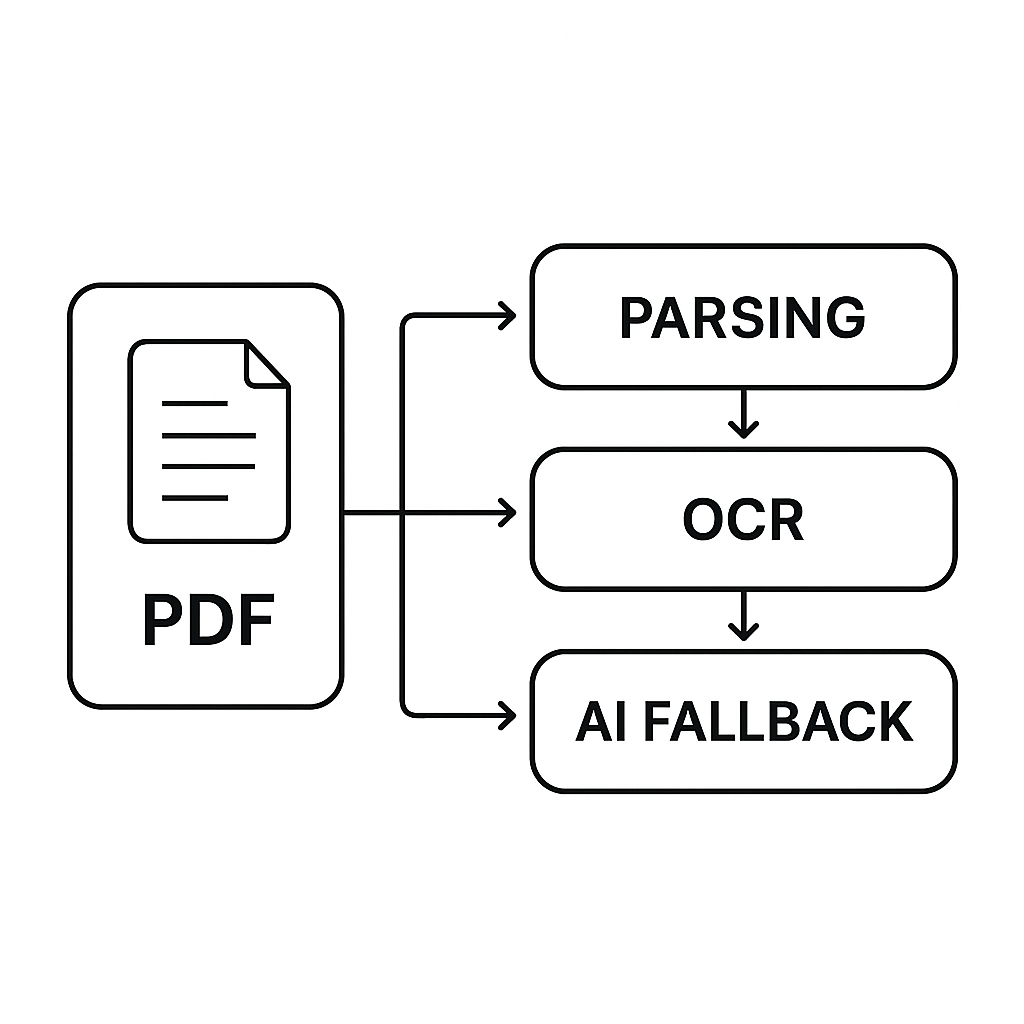
PDF → AI model → prompt → structured response
While AI is capable of understanding documents well, this approach incurs:
- Token costs and API latency
- Additional failure points and debugging complexity
- Privacy and data-handling concerns
Often, the PDF contains structured text, form fields, or predictable layouts. Traditional parsers or simple OCR can extract information reliably and instantly:
PDF → parser/OCR → field extraction → validation
AI should only be a fallback if these methods fail or are ambiguous:
PDF → parser/OCR → validation → AI fallback if needed
The Value of Using AI as a Fallback
This pattern is broadly applicable beyond PDFs.
Established business processes often include APIs, databases, business rules, and reliable structure. Using these first ensures:
- Faster processing
- Lower costs
- Clearer failure states
AI should kick in only when:
- The structured approach is unclear
- Interpretation beyond fixed rules is needed
- Unstructured or ambiguous information arrives
In this way, AI becomes a complementary layer, not a constant drain on resources.
Hybrid Systems: The Best of Both Worlds
Instead of Input → AI → AI → AI → Output, a more effective design is:
Input → existing systems → deterministic processing → AI when necessary → validation → action
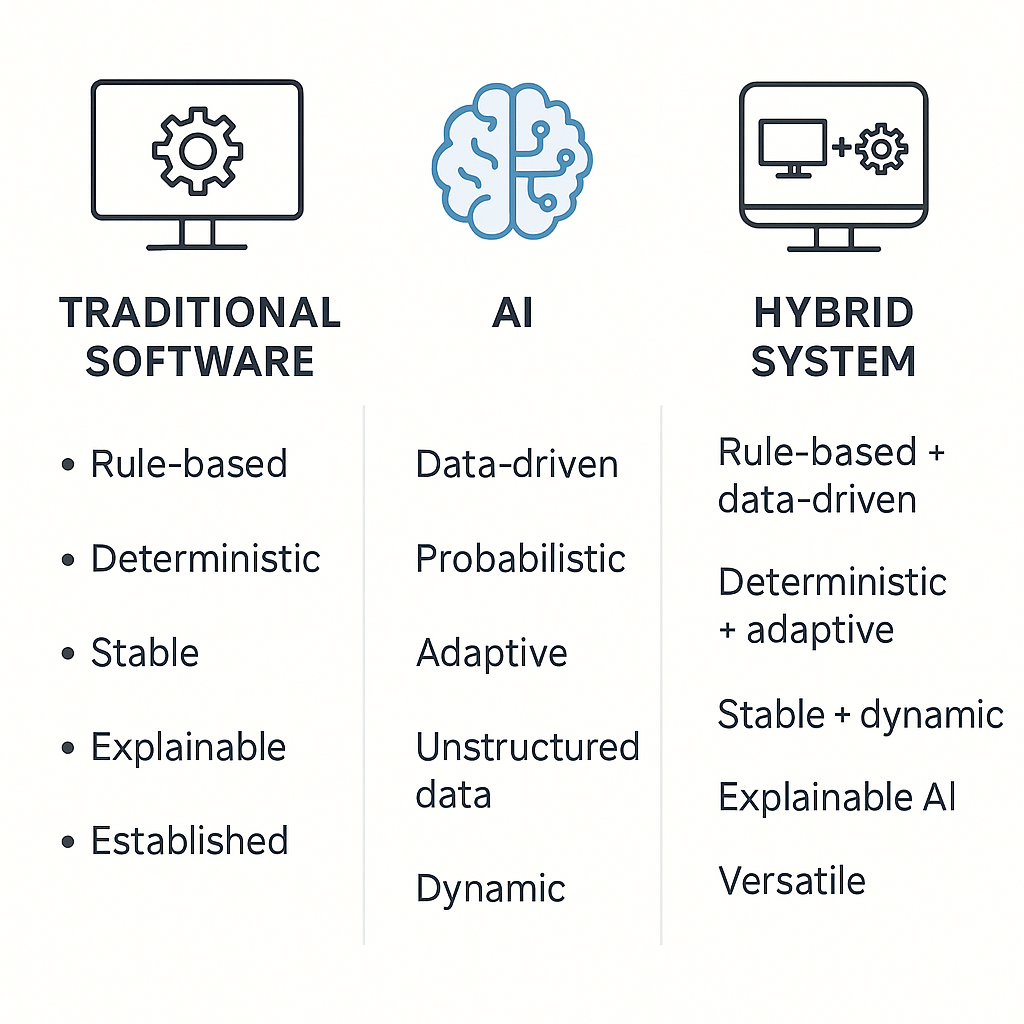
Traditional Software
- Predictability
- Speed
- Low operating costs
- Easy testing
- Clear failure states
AI Systems
- Language understanding
- Semantic classification
- Flexible interpretation
- Handling unstructured info
- Reasoning beyond fixed rules
Combining both lets you create solutions that balance cost, speed, and flexibility.
A Simple Rule of Thumb for AI Use
Before integrating AI, check if existing systems can resolve the task reliably via:
- API calls
- Database queries
- Parsers or business rules
- Local OCR
- Structured metadata
If yes, start there. Keep AI ready to step in only when ambiguity arises.
How LeonLab Approaches AI and Automation
At LeonLab, we prioritize your existing structure. We connect your APIs, databases, and workflows first.
AI is integrated selectively—as a fallback or for tasks needing semantic understanding of unstructured or ambiguous data.
This strategy avoids unnecessary AI costs and latency, maximizing reliability while leveraging AI where it matters.
Conclusion
Not everything needs AI. The smartest automation uses structure first and applies AI selectively as a fallback.
This creates workflows that are simpler, faster, cheaper, and more reliable—freeing AI to add value only where it truly belongs.
FAQ: Can I do this with LeonLab.ai?
Yes. With LeonLab.ai, you can seamlessly integrate traditional APIs and databases alongside AI capabilities, creating hybrid workflows that use structure first and AI only when needed. This lets you automate smarter with fewer AI calls, lower costs, and improved reliability.